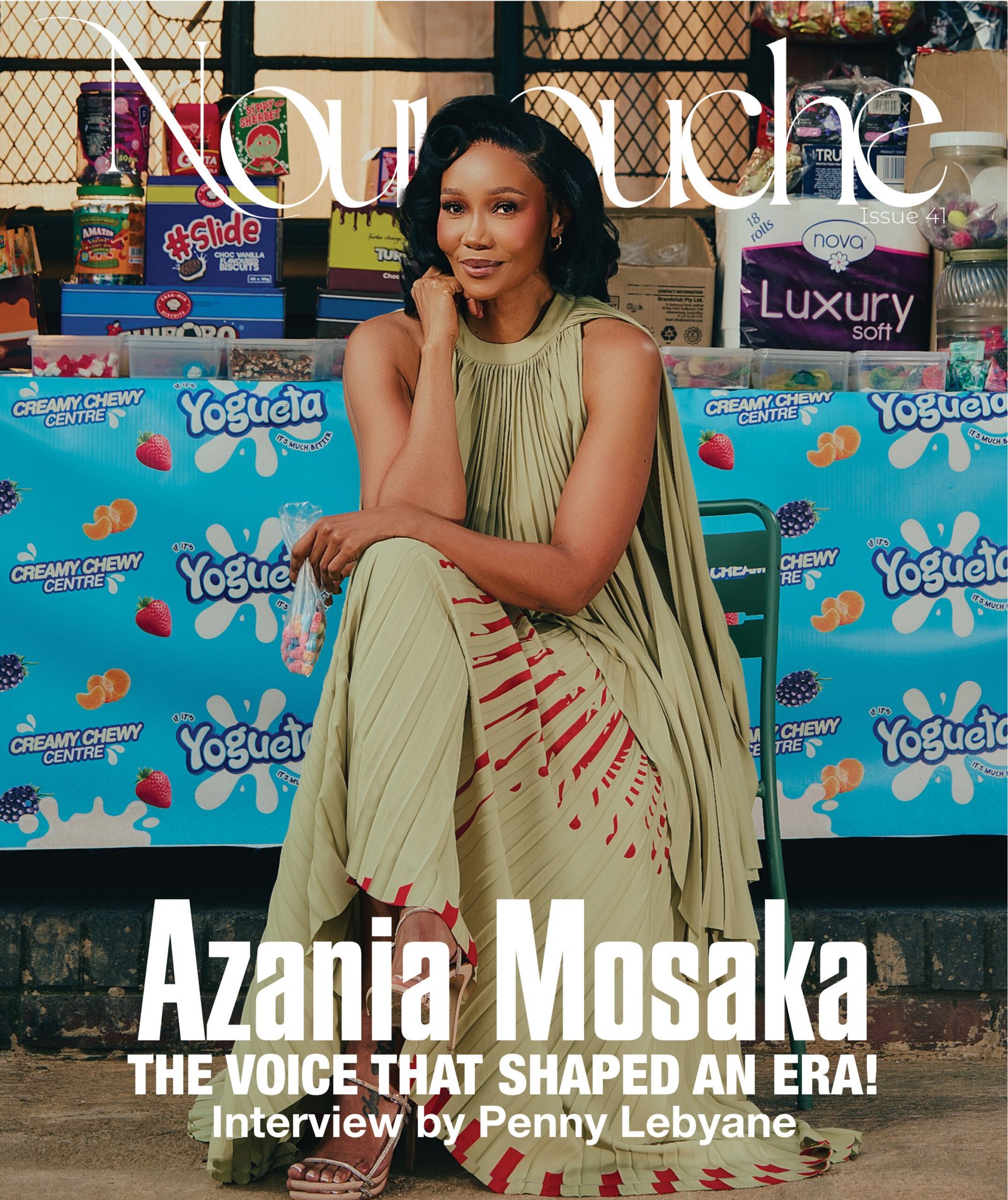
“THE NEXT CHAPTER IS HERS” Azania Mosaka on growth and building beyond the spotlight
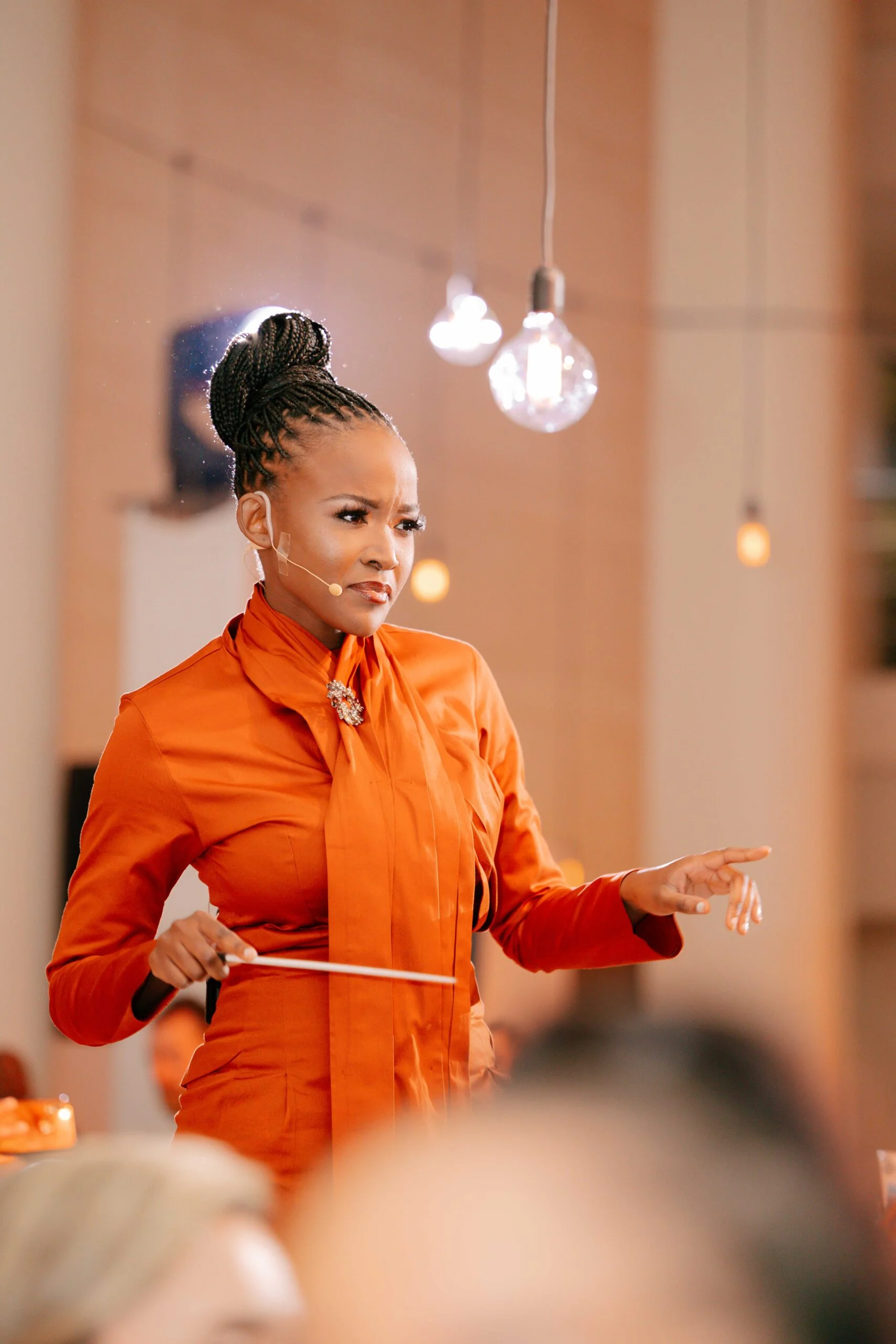
Azania Mosaka grew up in Pimville, a curious and deeply introverted girl, raised by a mother who modelled self-sufficiency without ever making a speech about it. While other kids were out on the streets, she was inside, watching television, listening to radio, letting those mediums become, as she puts it, “my teachers, my friends, my companion.” This was the beginning of a love affair that would define her life.
When Bonnie told me we were going to shoot a magazine cover with Azania, I lost my mind a little. She is someone I have admired for a long time, and someone I know Bonnie looks up to as well. So, to have the opportunity to sit down and write about her, and to experience her through the remarkable lens of Penny Lebyane, feels incredibly refreshing.
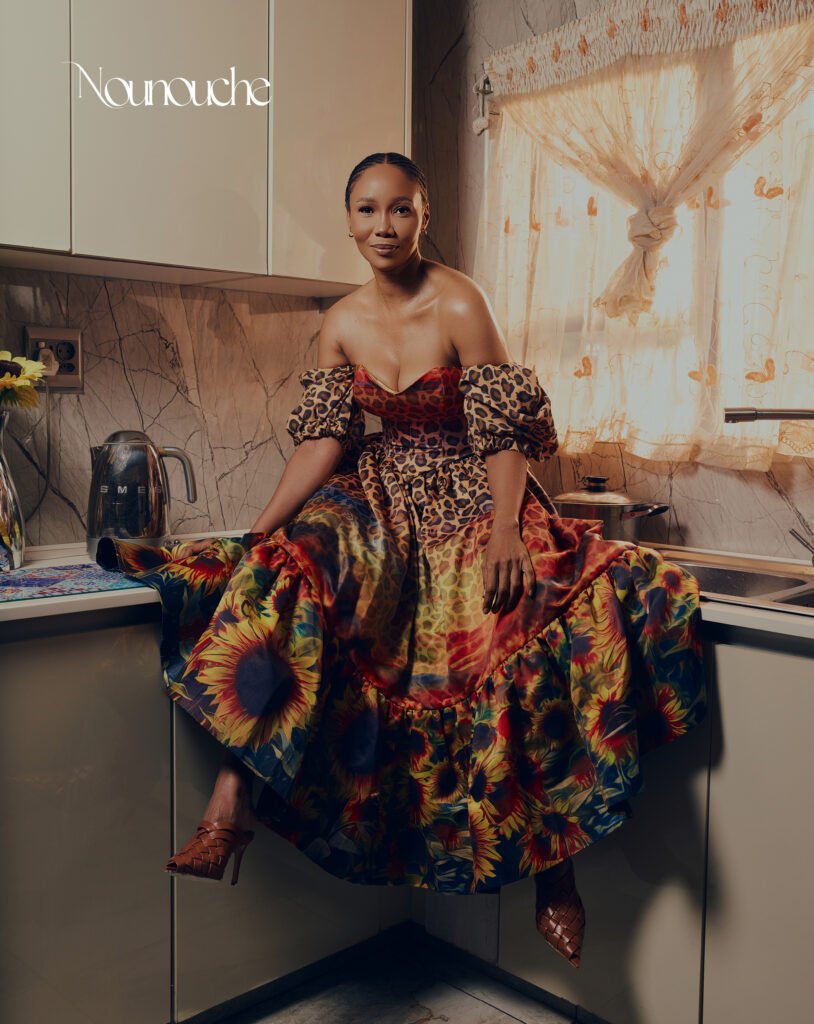
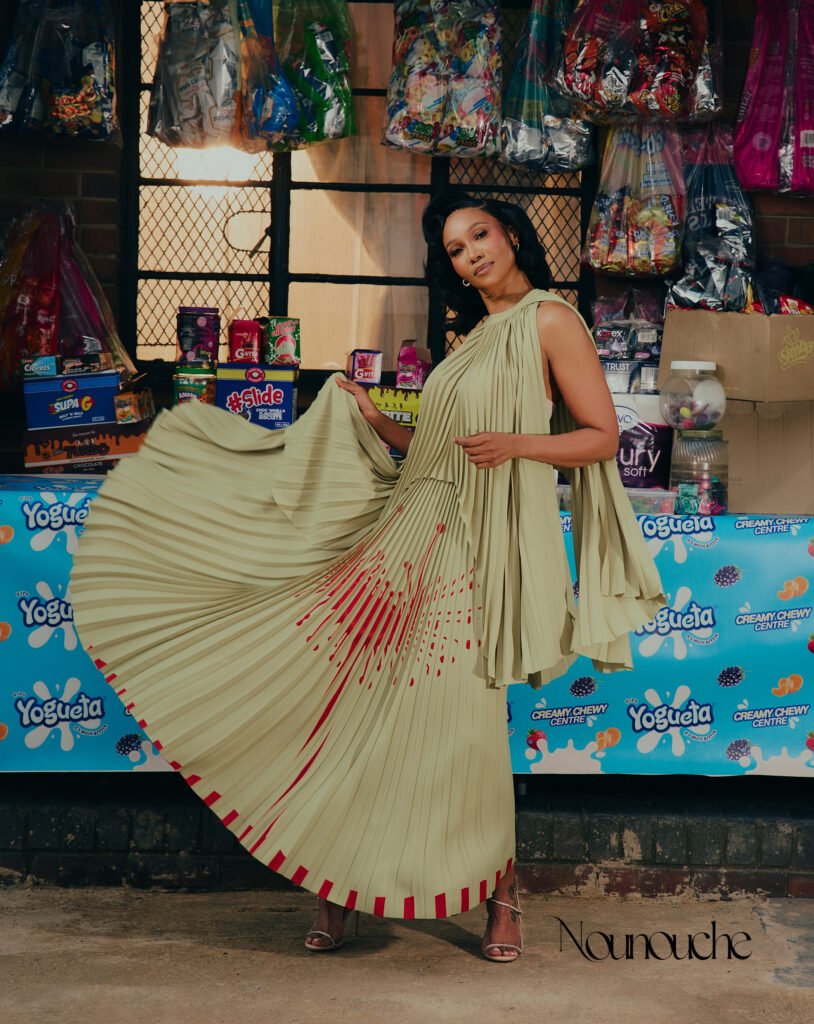
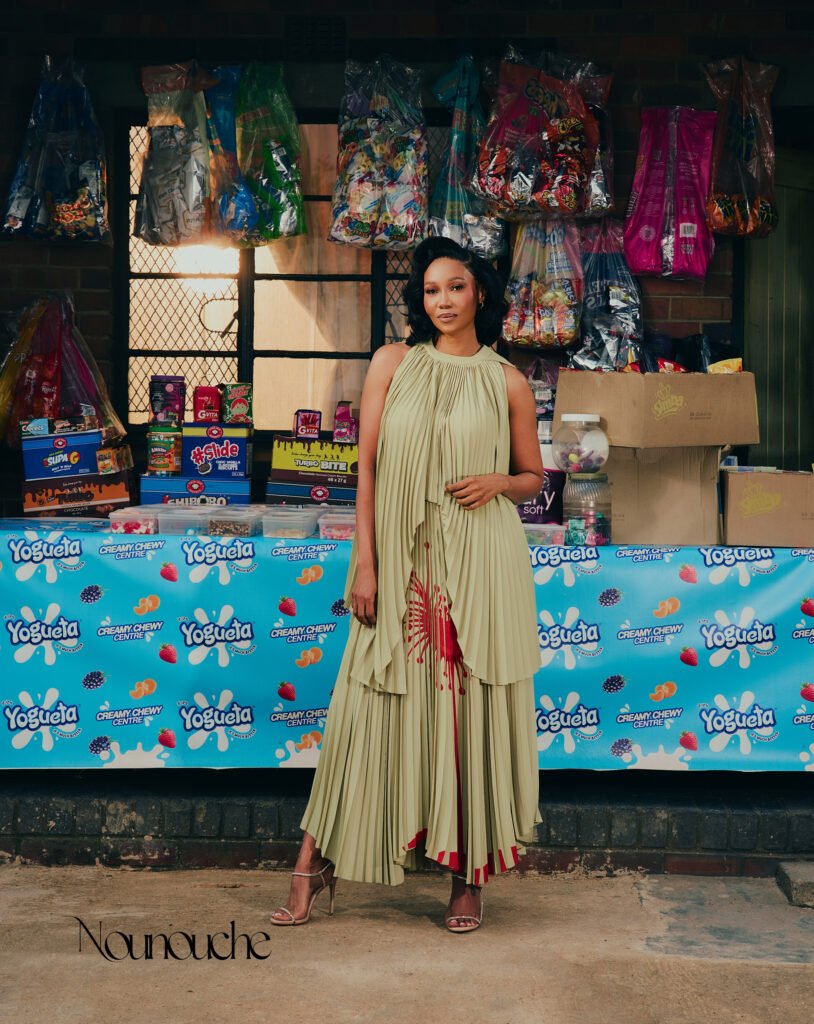
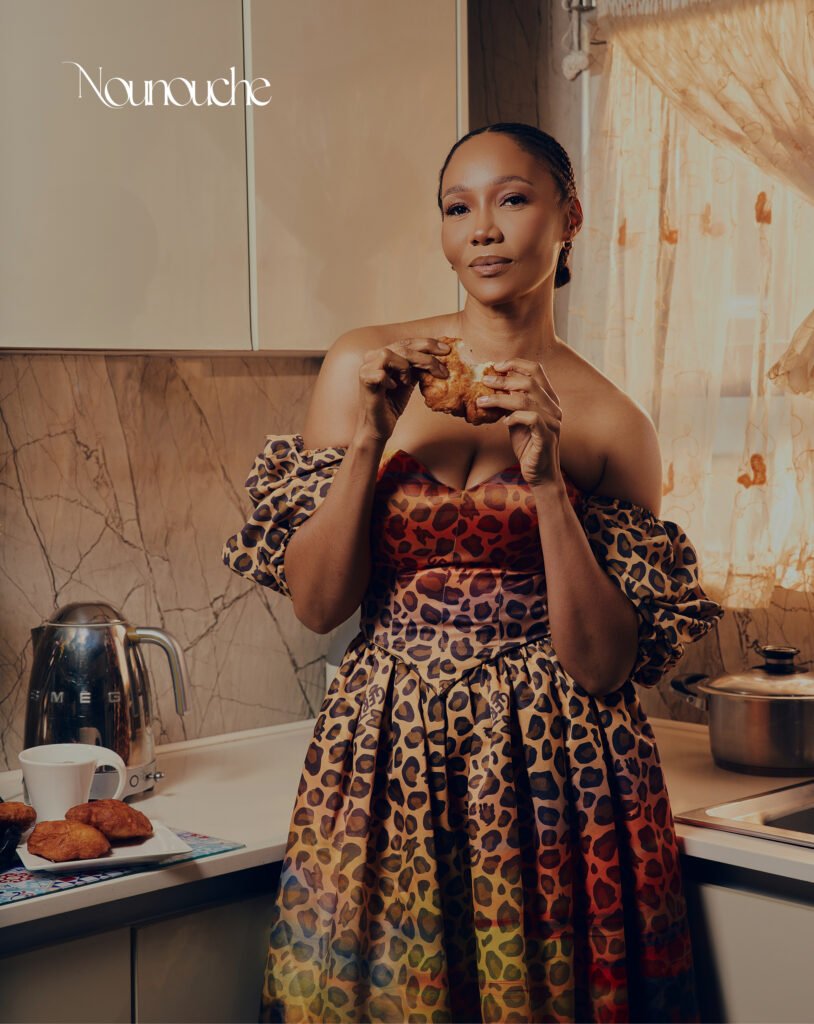
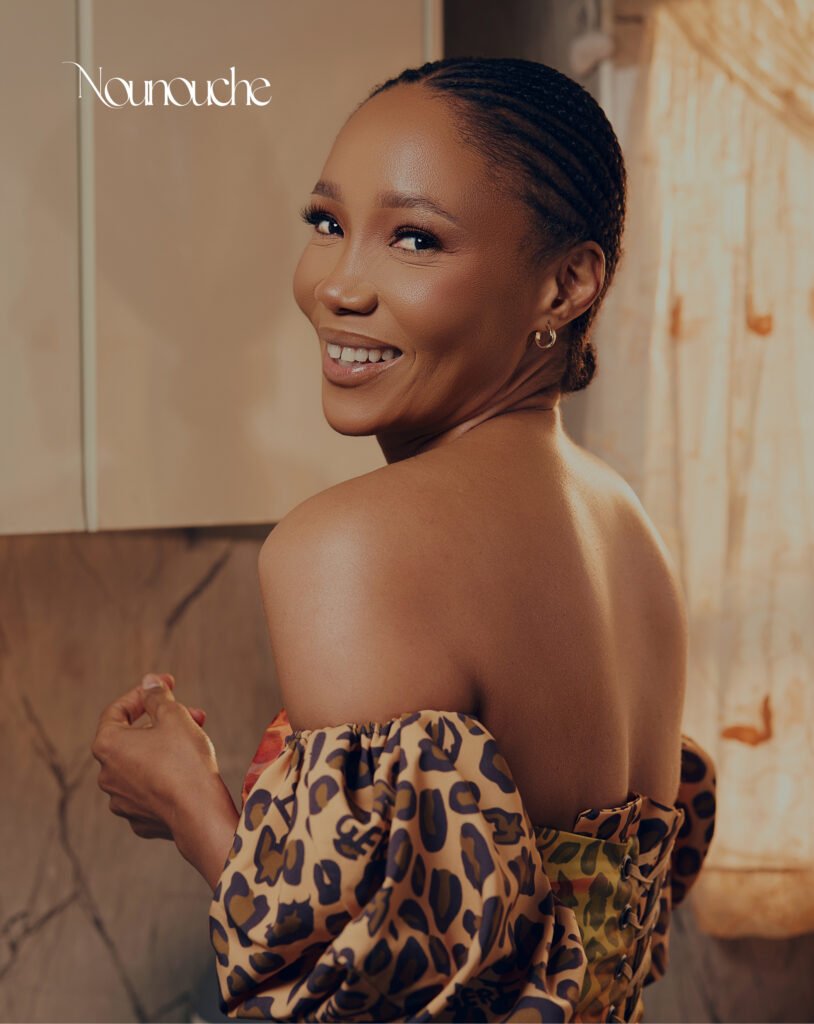
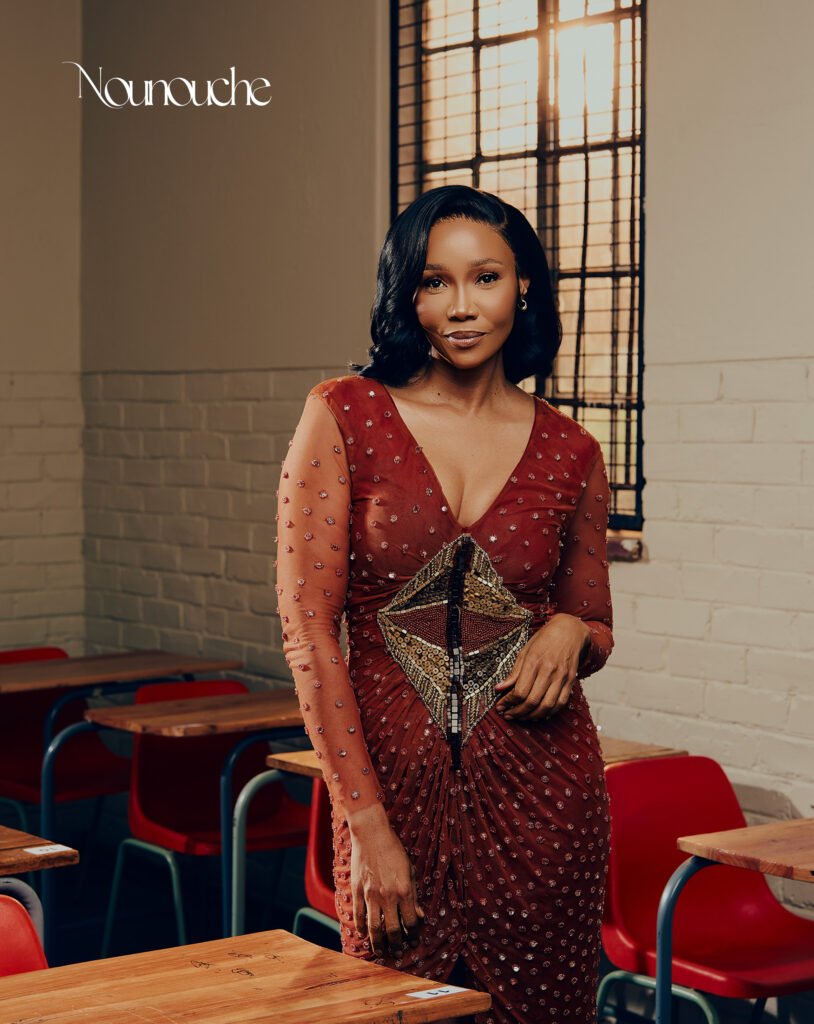
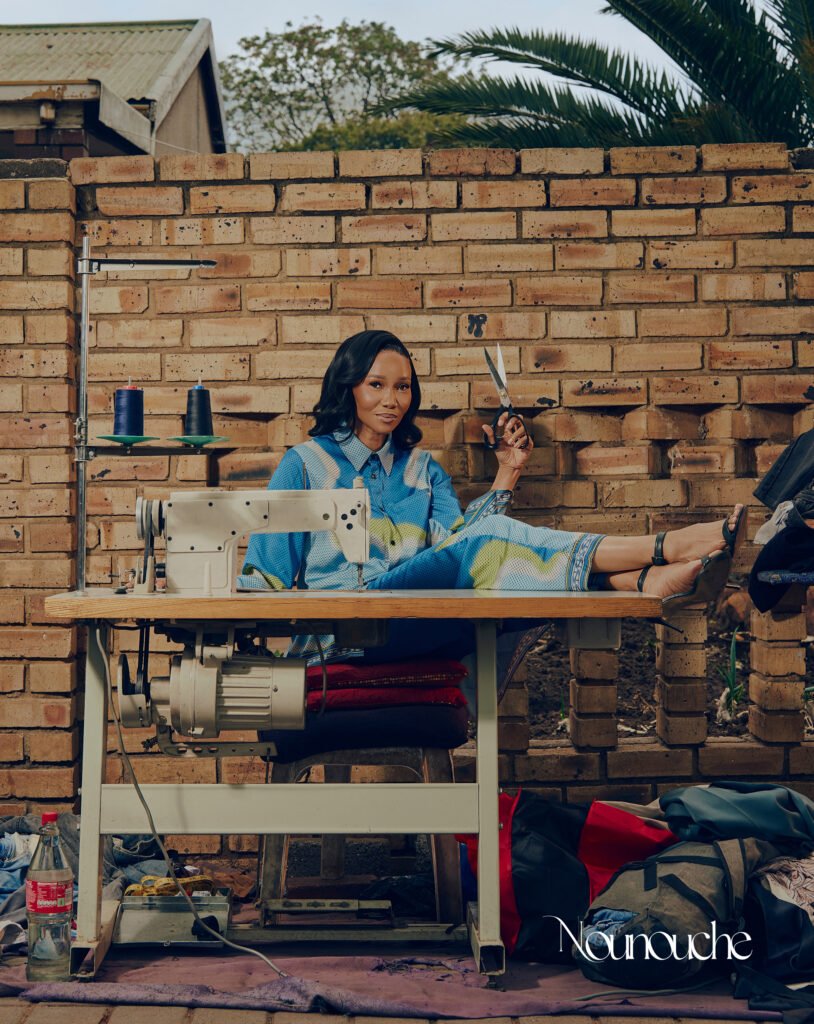
We had initially shot her cover in February this year but we felt we needed more, to tell her story a little more differently and with more texture. We headed back to Soweto, shot at her cousin’s house in Phefeni, Orlando West, then at the neighbouring school, at her cousin’s salon, and this is where we got the best of her. She is fun, engaging, down to earth, kind and loved by many.
At just 18, Azania stepped in front of cameras as co-host of the youth talk show The Joint on SABC1. Radio, though, claimed her fully and completely. She began at Metro FM as a producer, earned her way through the gruelling graveyard shift and eventually landed one of the most competitive slots in the industry: afternoon drive. Then came the moment that made history. She became the first woman to host a breakfast show on a commercial radio station in South Africa.
From The Sound of Breakfast to the beloved Total Bliss, through to The Azania Mosaka Show at Radio 702, she built a career defined by depth, composure and an unwavering sense of self. More than two decades later, her voice remains instantly recognisable. Longevity, as Azania will tell you, was never accidental. It was intentional.
For most of her adult life, Azania Mosaka’s voice was a constant presence in some of South Africa’s leading radio stations. Warm, assured and instantly recognisable, her voice travelled through car radios, office speakers, and kitchen counters, weaving itself into the daily rhythm of millions of lives. She was a gifted broadcaster with the poise of a woman who knew exactly how much of herself to give and how much to keep.
She was extraordinary at it.
And then one day she put down the microphone, stepped away from the studio and walked away.
What followed would surprise everyone except Azania.
Some cover stories are built from formal questions and carefully prepared answers. This one was different because it began with a soft giggle and “hey girl, it’s been a while.”
When Azania Mosaka and Penny Lebyane sat down together, the interview quickly turned into a long overdue conversation between two women who are at ease and safe in each other’s presence.
Watching them together felt like witnessing a masterclass in Black sisterhood.
What follows is Azania Mosaka, unedited.
WHEN LEAVING WAS THE BRAVEST THING
After more than twenty years behind the microphone at some of South Africa’s leading radio stations, she made the decision to leave. Not because the work had dried up, but because she had more growing to do than the medium could hold.
“I had a lot of turmoil,” she admits, with the honesty of someone who has done the quiet work of sitting with herself. “I wasn’t quite resolved.”
She loved radio deeply. She still does. Daily broadcasting, particularly the relentless weight of talk radio’s news cycle, had begun to take something from her. “You’re on that negative news Kool-Aid so much that it changes your perspective. Being away was like this amazing break. I saw South Africa differently. We have so much going for us.”
What followed was not a retreat. It was an expansion.
She turned her energy toward an extraordinary opportunity: a role with the United Nations, based in Geneva. While South Africa speculated about where she had gone, she was operating inside one of the world’s most significant institutions.
“I got a great opportunity to work for the United Nations based in Geneva,” she says. “I was like, this is why I left — to expand myself, my skillset and just have a different experience. The perfect thing came along at the perfect time. My kids were at the perfect age.” She pauses, then adds with quiet certainty: “God’s timing.”
Living outside South Africa and engaging with global perspectives gave her something no number of years behind a microphone could have provided: distance and clarity. Now that she’s back home, she’s gained a new perspective and the ability to see her country and her own story from the outside.
She then went back to Wits University to complete her Honours degree in Journalism and Media Studies, finishing something she had left behind years earlier when life rushed her in a different direction. “I thought, let me stop wanting these things for my children and start attaining them myself,” she says. “Because sometimes we try to live our dreams through our kids, which can be horrifying for them.”
Now she has her sights set on a PhD. “I want to go all the way.” She sees education as far bigger than personal achievement. “Women, Black women, Africans — we need to contribute to the body of knowledge.” In Azania’s framing, a PhD is not simply a qualification, it is a form of legacy.
THE WOMAN WHO REFUSED TO PICK A TYPE
When Azania broke into broadcasting, the industry had very clear ideas about what kind of woman she should be.
She remembers a workshop where someone asked her directly: what kind of woman do you want to be on radio? The options, as presented, were a menu of archetypes. The bubbly girl. The tomboy. The damsel. They told her to pick one and stay in it.
She was genuinely confused.
“What do you mean? I just want to be myself. Why do I have to be either?”
Back then, women in the media were expected to stay in their lane. They had to talk about babies and homemaking, to be safe, palatable, easy to categorise and therefore easy to manage. Azania was none of those things. She had a perspective and a presence, and she refused to shrink. In doing so, she quietly and permanently expanded what was possible for every woman who came into the industry after her.
SISTERS IN THE BUILDING
The more Azania and Penny talk, the clearer it becomes that they were never simply broadcasting. They were intentionally building positive narratives.
They championed emerging musicians, fashion designers, artists, filmmakers and the evolving cultural identity of a new South Africa, not because a job description required it, but because they understood that a platform is a form of responsibility.
“We would champion fashion, we would champion music, we would champion art, we would champion culture collectively,” Azania says.
Back then, the industry liked to play the comparison game, manufacturing tensions and fake rivalries between Black women working in the same space. Azania and Penny chose to be part of a generation that moved together instead.
Both women, independently and without ever discussing it with each other, refused that narrative entirely.
“I refused with my entire life, I used to tell them that we are not in competition” Penny recalls, her voice steady and certain.
What neither knew at the time was that Azania had drawn the exact same line, from her own conviction, without any coordination between them. When they finally discovered that truth about each other, something settled between them, a confirmation that what they had always sensed was real.
“When I found out that both of us had the same stance,” Penny says, pressing a hand to her chest, “it always just warms my heart.”
Even when the world tried to separate them, the deeply sacred bond of Black sisterhood held.
FREE AND FULLY HERSELF
They arrive at the subject the way old friends approach honest territory: sideways, through warmth, then landing somewhere refreshingly real.
Perimenopause.
“Last year from June, I started noticing these changes,” Azania says. “I was like, what the hell is going on?”
She is well-read and well-informed, but she soon realised there is a significant gap between understanding something intellectually and feeling it in your body.
“Sleep is elusive,” she says. Penny exhales beside her in quiet, knowing agreement.
With age has come a freedom Azania could not have anticipated in her earlier years. She speaks openly about the times she felt insecure about her height and her weight, about the years of absorbing messages that her body should look different, be different, fit a narrower template of what a woman on air was supposed to look like. That chapter is firmly closed.
Growing older, she explains, brings with it a subtle and deeply personal evolution: the liberation of no longer measuring yourself against other people’s expectations.
“Ke sharp,” she says, with the ease of someone who has genuinely stopped monitoring the room for approval. “I don’t care who says what.”
A soft laugh follows. Then, simply and completely: “I am enough.”
Azania has a Still I Rise tattoo, Maya Angelou’s words, inked permanently on her body chosen and claimed entirely as her own.
“I revisit that poem from time to time,” Azania says quietly.
Some things do not need to be explained. They simply need to be kept close.
BUILDING HER OWN THING
As the conversation settles toward its close, something shifts.
Both women have spent their careers showing up brilliantly for other people’s platforms, pouring their talent, their taste, their relationships and their reputations into institutions that were undeniably better for having them.
There is not a trace of resentment between them. What sits in its place is the honest confidence of two women who have always chosen growth over grievance.
Azania is looking at something different now.
“I think I’m building my own thing now,” she says.
Penny leans forward slightly, a smile breaking across her face.
“We’ve been contributing to other people’s things. Bringing our talents to other people’s things. Now it’s time to build our own stuff.”
There is a spark in their eyes and the shared smile of two women who know, without needing to say it plainly, that the time is now.
STILL RISING, AND ONLY JUST BEGINNING
I have been thinking about what it means to spend twenty years being very good at something and then have the courage to ask: what else?
Not out of dissatisfaction. Not out of failure. But out of the freedom and confidence that comes to a woman who has done the inner work and arrived at a place of genuine self-knowledge. The kind of courage that says: there is more in me than this, and I intend to find out what it is.
Today, a new generation of young women are stepping into South Africa’s television and radio sectors with more doors open than ever before. Those doors did not open on their own. Women like Azania Mosaka pried them open, quietly and persistently, by refusing to be what the industry wanted her to be and insisting instead on being entirely, stubbornly herself. She made the path. Others are walking it. That is legacy in its most practical and powerful form.
She is, as at the beginning of her most interesting chapter yet.
“Growth should never have an expiry date.”
No Comments