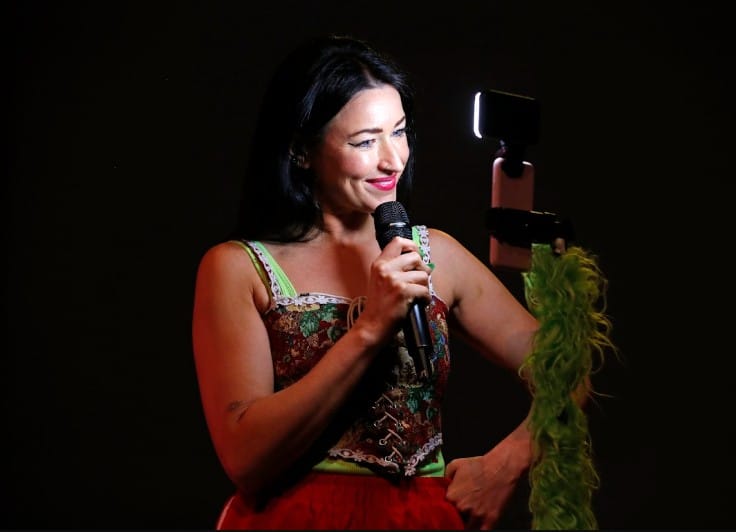
During the opening moments of Famehungry, the true-crime girlie in me couldn’t stop thinking about women like Valeria Márquez, Janice David and others whose lives ended while livestreaming on social media. Before the performance had fully settled in, it had already raised an unsettling question: do we really understand the risks of broadcasting our lives online? We speak about privacy settings and metadata as though they offer protection, but how safe are they, really?
That question lingers throughout Louise Orwin‘s performance. Playing a TikToker named Louise, she dismantles the logic of internet fame with equal parts humour, vulnerability and self-awareness. Much of what fuels social media, she suggests, is repetitive content recycled into an endless algorithmic loop — “a black hole of nothing,” as she puts it. It is a brutal description of an ecosystem built on constant production, where creators are expected to perform relentlessly, often for very little reward. Louise laughs frequently throughout the performance, yet admits she’s laughing at nothing in particular. It is one of the show’s quietest, saddest observations.
For anyone unfamiliar with TikTok’s peculiar ecosystem, Famehungry doubles as an introduction. Louise casually decodes terms like shadowban, Barbiecore and vibe high, while setting herself an objective familiar to every creator chasing engagement: reach 20,000 likes, and the audience will be rewarded with “something amazing.” The promise itself is almost beside the point. The pursuit of attention has become the performance.
Orwin also interrogates the app’s effect on attention spans, identity and culture. One of the production’s more startling revelations is the suggestion that TikTok applies facial filters by default, whether users request them or not. For a platform that carefully moderates language, the contradiction feels striking. Louise points out that TikTok discourages creators from discussing the platform itself, while words relating to rape, politics, suicide, smoking and other issues central to public discourse are quietly penalised. The implication is difficult to ignore: what is considered unsuitable isn’t necessarily what is harmful.
The performance grows increasingly personal as Louise recounts moments from her career — enduring physically punishing performances, navigating sexual exploitation, accidentally baiting a paedophile and surviving acts of violence. These confessions are not offered simply for shock value. Instead, they expose the uneasy economy of oversharing that social media rewards. Vulnerability attracts engagement, yet the same stories can later become ammunition for online harassment. Famehungry asks whether the internet has blurred the distinction between authentic connection and public consumption.
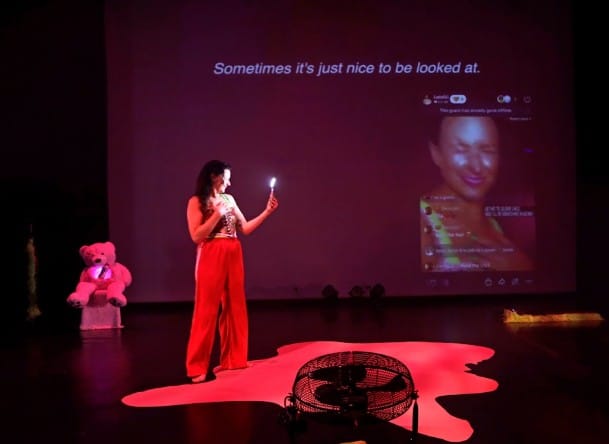
One of the funniest moments arrives during the “Queen of Delulu” sequence, which cleverly interrogates the fantasy of online identity. Louise remarks, “Sometimes it’s just nice to be looked at.” It is a deceptively simple line that captures the emotional engine behind so much online behaviour. Social media rarely reflects reality; more often, it reflects aspiration, performance and carefully curated illusion.
Perhaps the evening’s biggest surprise is Louise’s account of being underpaid, overworked and exploited despite building an audience in the United Kingdom. Much has been said about the poor monetisation opportunities available to African creators, but if British influencers are struggling financially, one can only imagine the economics elsewhere. If Louise is earning peanuts, African creators are probably not even getting the salted ones.
The production also reminds us that content creation is labour, complete with its own anxieties. Creators obsess over views, algorithms, relevance and the possibility of disappearing overnight. Their careers depend on systems they neither control nor fully understand. Louise’s honesty validates something many have quietly suspected: social media fame is remarkably fragile. No one knows whether influencers and content creators will still occupy the cultural landscape a decade from now or whether today’s digital economy will simply evolve into something else.
By the end, Louise concludes that TikTok is “hard, broken and corrupt.” It is a damning assessment, though one that feels strangely familiar. Long before social media, people navigated flawed institutions, unequal systems and impossible workplaces. Perhaps TikTok is less an anomaly than a mirror reflecting old problems through new technology.
Famehungry ultimately succeeds because it resists easy condemnation. It is funny without trivialising its subject, deeply personal without becoming self-indulgent, and critical without pretending there are simple solutions. Instead, it asks audiences to confront an uncomfortable truth: in the pursuit of being seen, we may have become increasingly comfortable surrendering parts of ourselves to systems that were never designed to protect us.

No Comments