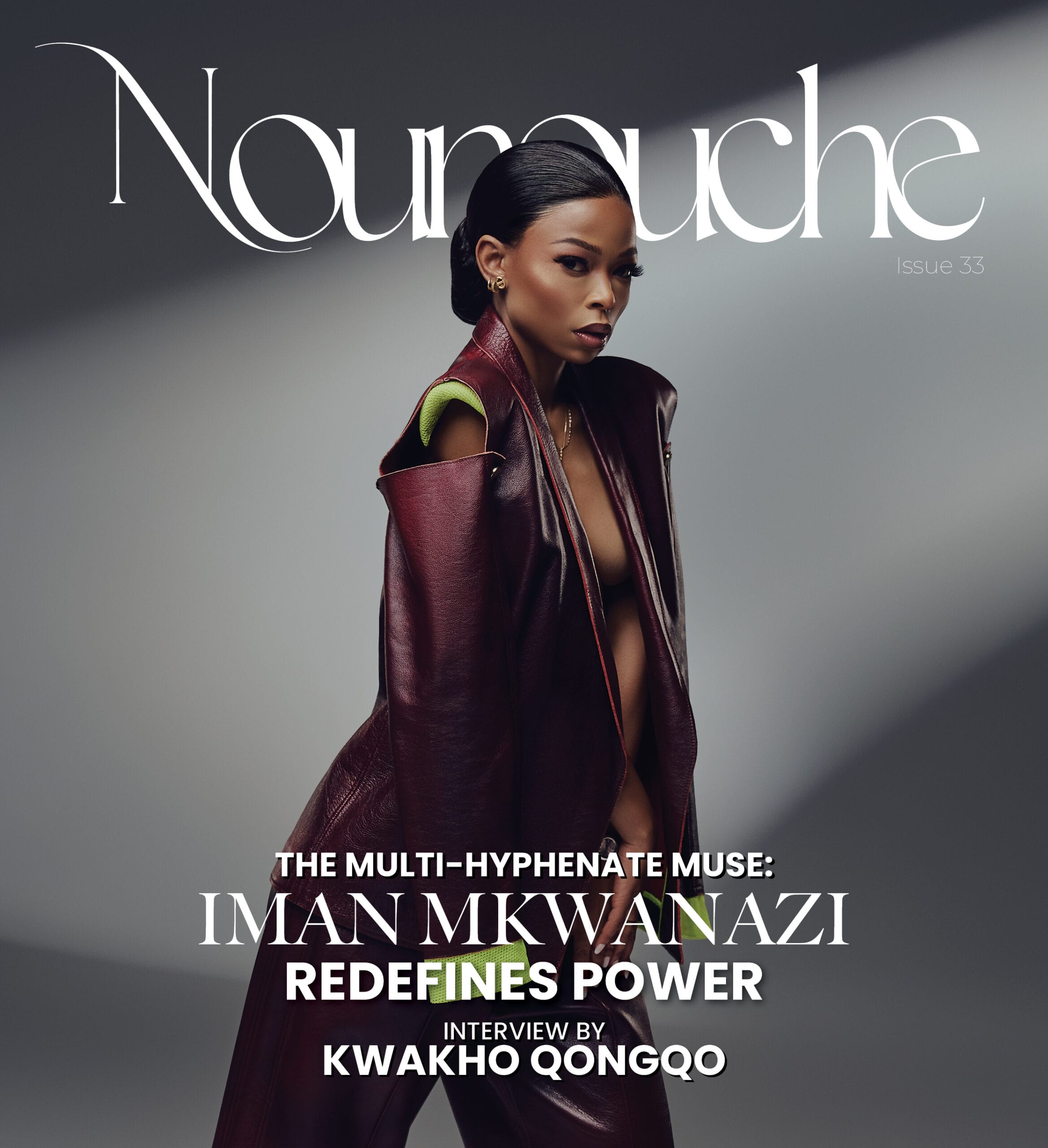
There was a time when South African models lived in glossy permanence. They were everywhere, suspended in the pages of fashion magazines, their faces part of a national visual language that felt both aspirational and intimately ours. You knew their names, their walks, their angles. They sold not just clothes, but a kind of possibility.
Then print folded in on itself. And with it, an entire ecosystem quietly dimmed.
Today, unless you are seated front row or orbiting the backstage chaos of fashion week, the visibility of South African models feels fleeting – momentary, algorithm-dependent, often unanchored from legacy. This issue, then, is an act of restoration. A deliberate pause to give flowers, not in passing, but with reverence, to the women who built the blueprint. The ones who carried an industry on their backs before it fragmented.
Women like Iman Mkwanazi.
Except Iman refuses to exist in a single narrative.
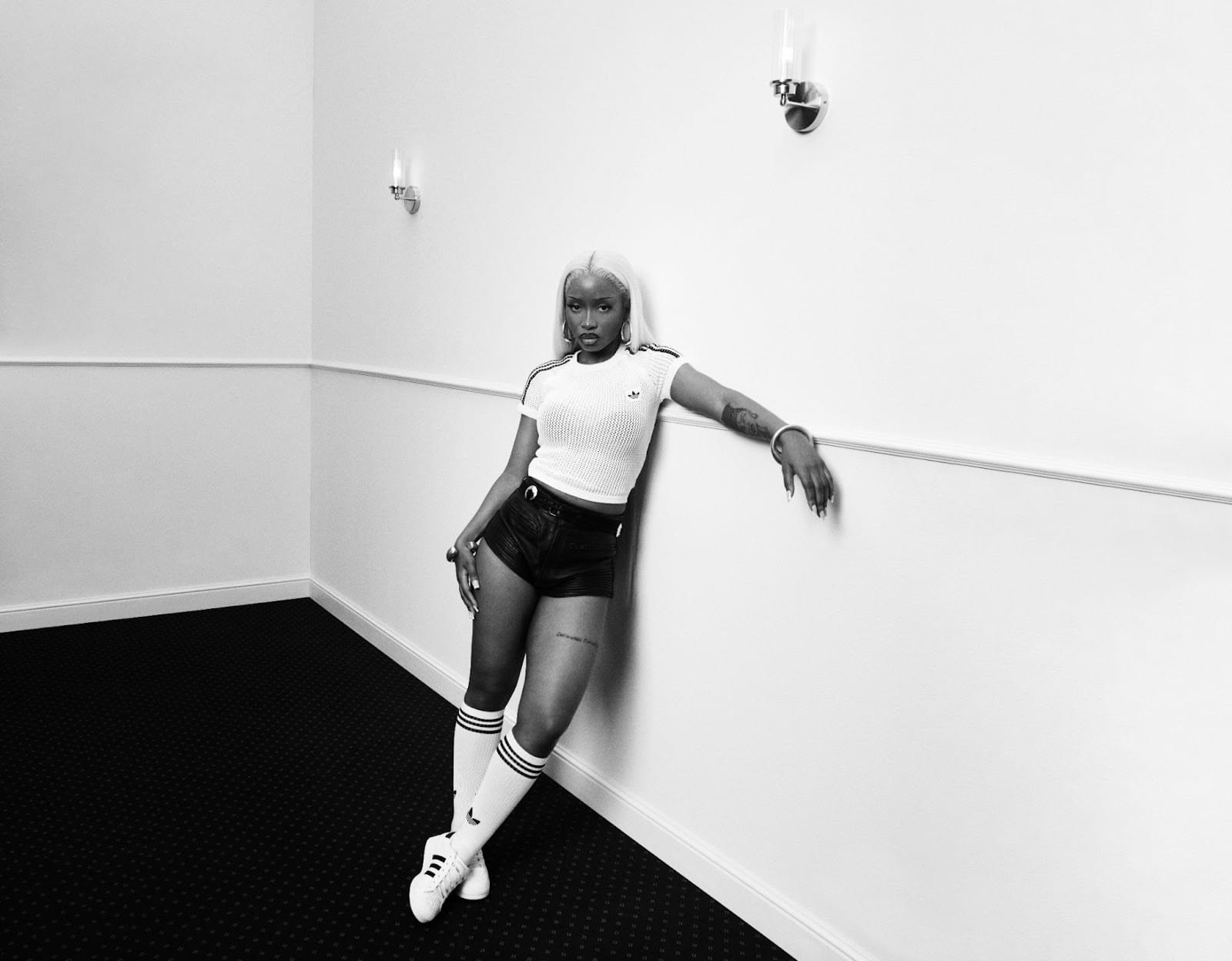
She is, at once, the archetype and the disruption: a former model who stepped off the runway and into boardrooms, laboratories, and lecture halls – accumulating not just campaigns, but degrees. A BSc. An MBA. A Diploma in Electrical Engineering. A mind that insists beauty has never been at odds with brilliance, only misread by those unwilling to see both.

Sitting across from her is Kwakho Qongqo – a former celebrated model, now a fashion designer (Kissa Moda founder) a woman who understands, perhaps better than most, what it means to be looked at, and what it takes to be seen.
“Hey, Miss Iman,” she begins, a familiarity softened by curiosity. “Finally, we get to sit down again – but this time, properly. I have so many questions we’ve never touched on.
They exchange glances and laughs.
Iman’s story begins not in spectacle, but in structure. Raised primarily by her father after her parents divorced when she was six, she speaks about it with a kind of emotional precision that feels less like detachment and more like clarity.
“I think you can actually see it in my personality,” she says. “I’m quite strong. My masculine energy is higher. My dad did a great job raising me”
Strength, in her case, is not posturing. It is lived. There is a story – one Kwakho recalls, of her physically confronting a man who harassed her. It is offered not as mythology, but as matter-of-fact.
There is also faith, another layer that complicates easy assumptions.
“I’m Muslim,” she says, almost anticipating the surprise. “I was born Muslim. I went to a Muslim school. I can read and write Arabic.”
In a cultural landscape that often flattens identity into singular narratives, Iman exists in multiplicity – Black, South African, Muslim, model, engineer, each facet fully realised, none diluted for palatability.
But it is in the way she speaks about emotional inheritance that something deeper reveals itself.
For many, divorce is framed as rupture. For Iman, it is reframed as choice.
“My parents are adults,” she says simply. “They made an adult decision to choose themselves.”
It is a perspective that feels unusually evolved, one shaped by early introspection, but also by a refusal to romanticise dysfunction.
“It’s actually better than being in a home where there’s constant fighting.”
There is no performance of trauma here. No attempt to mine pain for narrative currency. Instead, she speaks about love – abundant, stabilising, formative.
“I was really, really loved,” she says. “I’m so lucky for that.”
And yet, she is equally candid about the complexities that love does not automatically resolve. The tendency to overextend. The quiet realisation that empathy is not always reciprocated. The importance of therapy, not as indulgence, but as infrastructure.
“I think a lot of us believe we’ve processed things,” she reflects, “when really, we’ve just put them aside.”

It is this intellectual and emotional rigour that makes her pivot from modelling to engineering feel less surprising, and more inevitable.
When Kwakho asks about her academic trajectory, she even seems momentarily disarmed.
“A BSc, an MBA… and electrical engineering?” she repeats.
She shrugs, almost casually.
“I’m a science girl.”
The transition, she explains, was not born from reinvention, but from opportunity, a business acquisition, a shift into the energy sector, a natural alignment with her existing skill set.
What is striking is not just the pivot, but the ease with which she occupies both worlds.
Because if modelling is often dismissed as superficial, engineering is treated as its intellectual opposite – rigorous, technical, serious. Iman resists this binary entirely.
“In the beginning, I wanted to prove that I’m smart,” she admits. “Now I’m just like, I am a pretty face, and I am smart. And I don’t care if you don’t think I am.”
It is less defiance, more indifference. A quiet confidence that comes not from validation, but from self-containment.
“There’s a stigma,” she continues. “Not just about models, but about pretty women. Even when people know you’re smart, there’s still that bias.”
The difference now is that she no longer feels compelled to correct it.
“If it doesn’t appease you,” she says, “I simply cannot help you.”
There is, in that sentence, a kind of freedom.
And yet, fashion – that first love, has not been abandoned. It has simply evolved.
Through The African Collective Studio, Iman is re-entering the industry not as muse, but as architect. Co-founded by Sibongile Mbongo, Buntu Giyose and Iman, they are designing a platform that champions African luxury designers, not as an offshoot of European frameworks, but as a fully realised category in its own.
“We focus on craftsmanship, authorship and heritage,” she explains. “African luxury has always existed. It was just never defined by us.”
It is here that the conversation shifts from personal to political.
Because for Iman, fashion is not just aesthetic, it is economic infrastructure. It is trade, manufacturing, authorship. It is the question of who gets to define value, and who benefits from it.
“We don’t need to manufacture scarcity,” she says. “In Africa, it already exists.”

What is required, she argues, is not imitation, but documentation. A deliberate, collective effort to formalise African luxury on its own terms, to write the white papers, build the markets, create the systems that allow designers to scale without dilution.
“It’s not just about speaking,” she says. “It’s about putting pen to paper.”
Kwakho pushes further, what about accessibility? What about the lower-income consumer, priced out of luxury narratives?
Her response is pragmatic.
“You start with the market that can sustain it,” she says. “And then you grow.”
It is a long game, one that requires patience, collaboration, and a fundamental shift away from individualism towards collective action.
“A scrum,” she calls it. “You push together.”
And yet, for all the ambition, there is an unexpected softness when the conversation turns inward again.
“What does peace look like to you?” Kwakho asks.
“Consideration,” she answers. “Just… being considered.”
It is a simple answer, but it lingers.
Because for someone who moves across industries, disciplines, and identities with such velocity, what she ultimately seeks is not dominance, but balance.
Her favourite work, she reveals, is engineering, not for prestige, but for purpose.
“We’re providing energy to communities,” she says. “That’s a five, ten-year impact.”
Fashion, she admits, is passion. Engineering is fulfillment.
And love?
“I don’t want to see people,” she laughs. “I’m an introvert.”
It is almost disarming, this refusal to perform the social expectations often attached to her image.
In an ideal future, she does not envision excess, or empire, or even legacy in the traditional sense.
“I want to make enough money to travel. Live well. That’s it.”
No billion-dollar ambition. No performative hustle.
Just balance. Spiritual, emotional, internal.
When asked about her proudest moment, she pauses.
“I’ve done so many things,” she says. “I don’t even celebrate them.”
Perhaps that is the point.
Iman Mkwanazi does not exist for applause. She exists in motion, between disciplines, between definitions, between expectations. A woman who once occupied the pages of magazines, now quietly reshaping the systems that decide who gets to be in them.
And in doing so, she offers something far more enduring than visibility.
She offers a new narrative. One where beauty does not need to justify its intelligence. Where fashion is not separate from intellect, but in conversation with it. Where African luxury is not derivative, but declarative.
And where the women who came before are not forgotten, but finally, fully seen.
Stockists
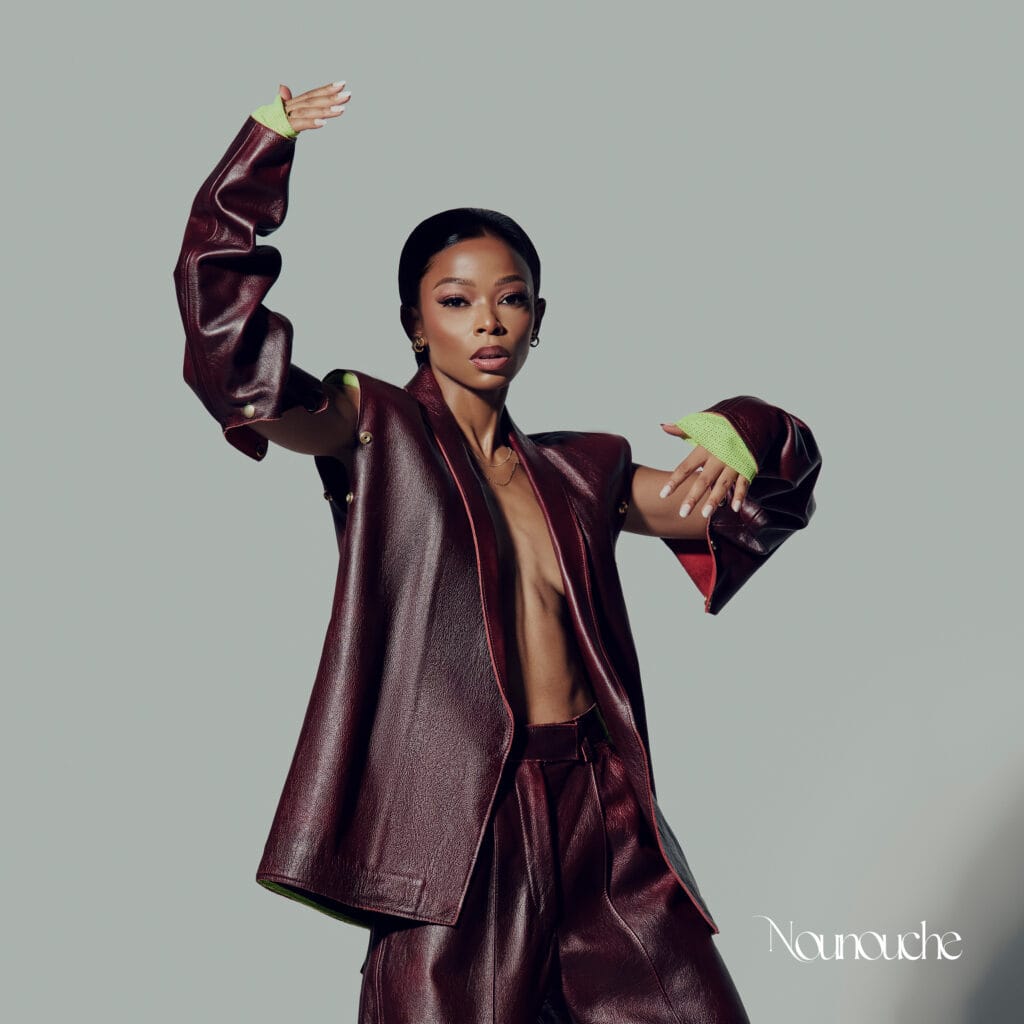
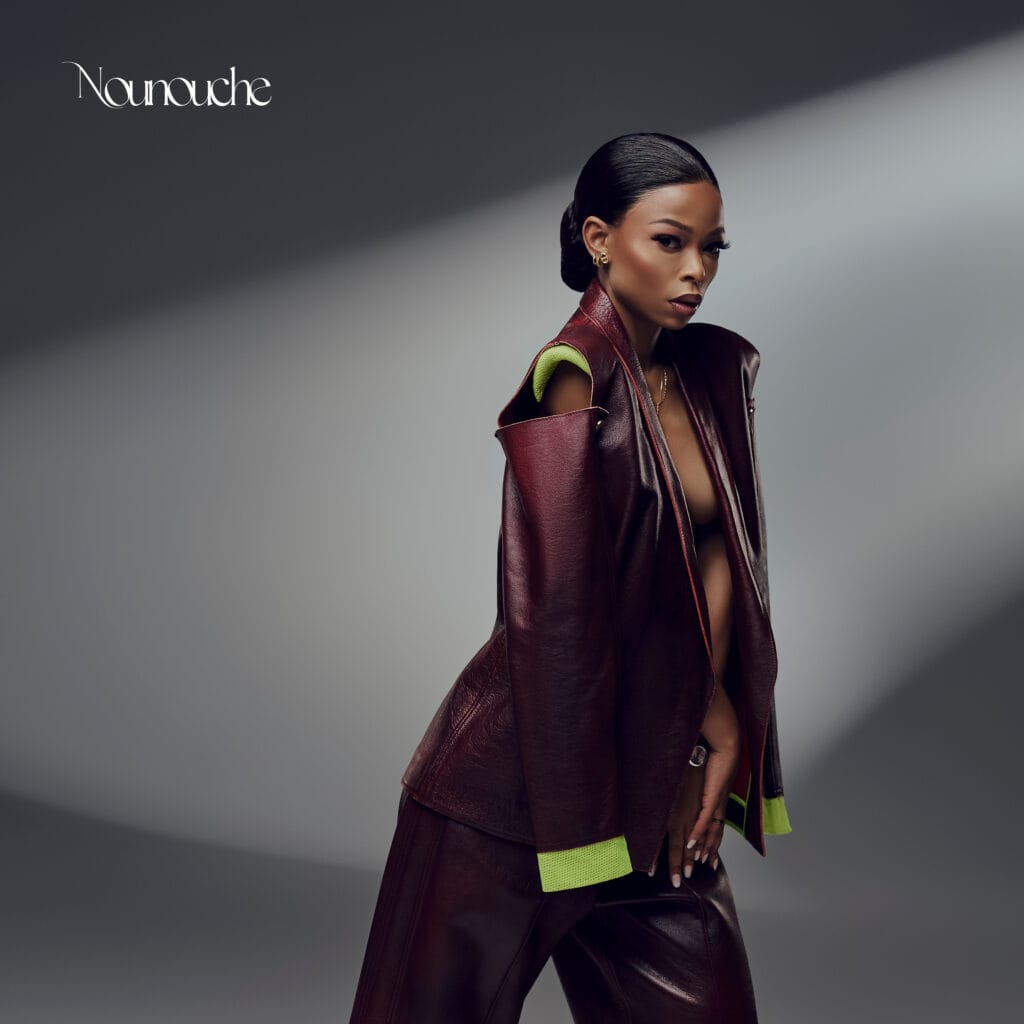
Burgundy blood jacket and pants Viviers studio @vivers.studio

No Comments