
There are people whose presence feels like sunlight, steady, warm, unmistakably life-giving. Even over a remote interview call, Homba Mazaleni shines in that way. Her joy is not the brittle kind that cracks under pressure, nor the curated gloss of a digital age obsessed with performance. It is lived-in joy: intentional, thoughtful, and born of deep inner work. It is the kind of joy that feels both earned and generously shared.
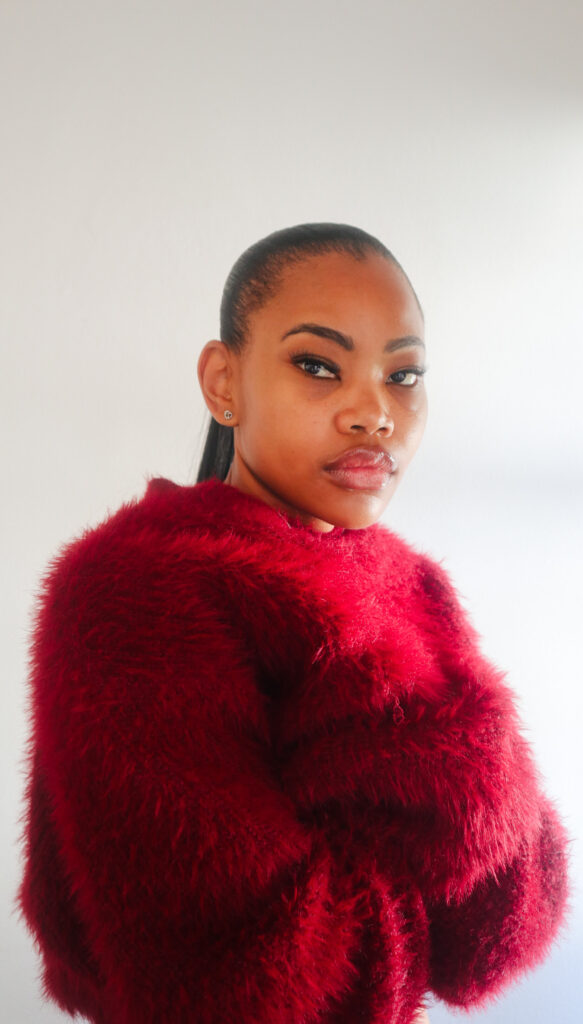
At 26, Homba carries herself with the expressive honesty of someone who understands that life is rarely tidy but always rich. “I give myself space to feel things,” she tells me early on. “If I’m tired, I allow myself to feel tired.” If she’s not okay, she acknowledges it. That, for her, is a form of love. It is this commitment to self-truth without self-indulgence that forms the quiet backbone of her radiance.
And the world has noticed.
Ask anyone who follows Homba online, and they will tell you that her defining trait is joy; bright, infectious, unforced. But to her, it is not a constant state. “It’s not every day that I feel like this,” she admits. “But I’m lucky because I get to curate the world’s perception of me. In my real life, I give myself permission to feel.” Her happiness is therefore not a costume but a consequence, a natural overflow of the inner tending she insists on doing.

She laughs as she reflects on how long it took her to believe in her own brilliance. Failing her second year of university “dismally,” as she puts it, rattled her confidence. Others saw what she could not yet grasp: intelligence, beauty, presence, but she struggled to internalise their praise. Eventually, with a nudge of faith, she tested it. She entered Miss South Africa 2023. She placed in the Top 5.
“If people keep telling you great things about yourself, maybe they’re seeing something you’re not seeing yet,” she says. “At some point, I thought…let me put it to the test.”
Today, Homba is a practising Biokineticist at the Sports Science Institute of South Africa. The journey into movement science began on the cricket field, where she played at provincial and Proteas emerging-team level. “I loved the teamwork, the beauty of the sport,” she says, recalling the first time she encountered a physiotherapist and realised how transformative proper medical attention can be for athletes, especially women, whose sports were often sidelined.
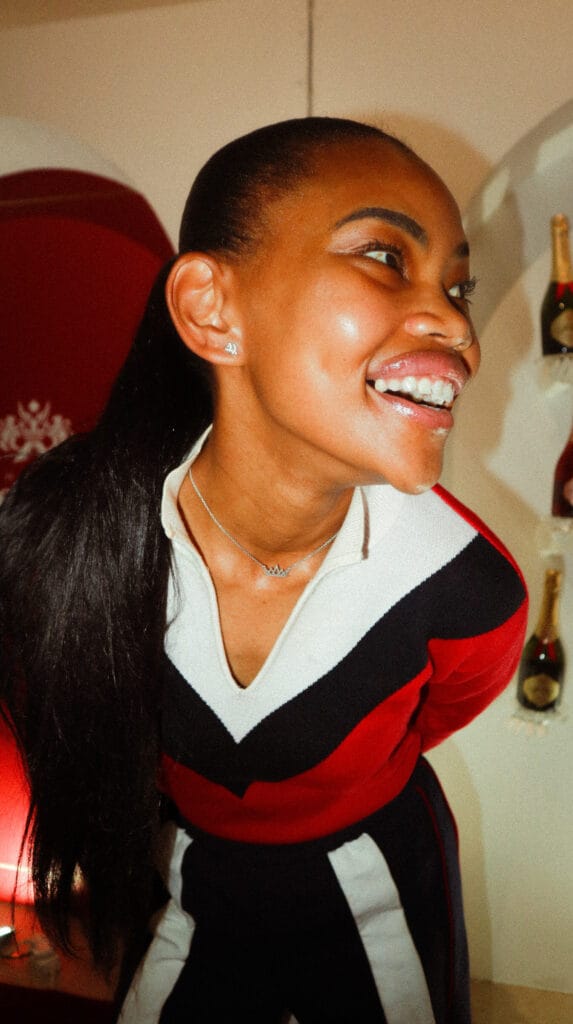
Biokinetics gave her the perfect fusion of high-performance sport and medicine. It also gave her purpose. She speaks with softness about her patients: a woman navigating Parkinson’s with striking optimism; a young girl wrestling with body image after years of bullying. “If I can help her love her being, Homba says, “why wouldn’t I want to be that for her?”
Her workdays are long; she began at 06:30 on the morning of our interview, and on earlier days, her first patient is at 05:30, but she carries the hours with grace. “It’s easy to be joyful when things are going your way,” she reflects. “But when you’re tired, when you’re stretched, how you respond matters.” She guards her peace carefully, fully aware of the cost of losing it.
Alongside the rigours of Biokinetics, another path is calling: presenting, speaking, and social media. She loves the craft of communicating, its precision, its lyricism, its capacity for connection. “All I’ve known is academics,” she says, “but the side hustle has done really well. I can’t imagine what it would look like if I gave it more time.” She is at a crossroads, one that feels less like confusion and more like expansion.
When I ask whether she still hopes to study the relationship between happiness and neuroscience, her eyes light up. A master’s degree is still on the horizon, but she wants to choose it for herself—not out of obligation or expectation. “This time, it will be of my own accord,” she insists.
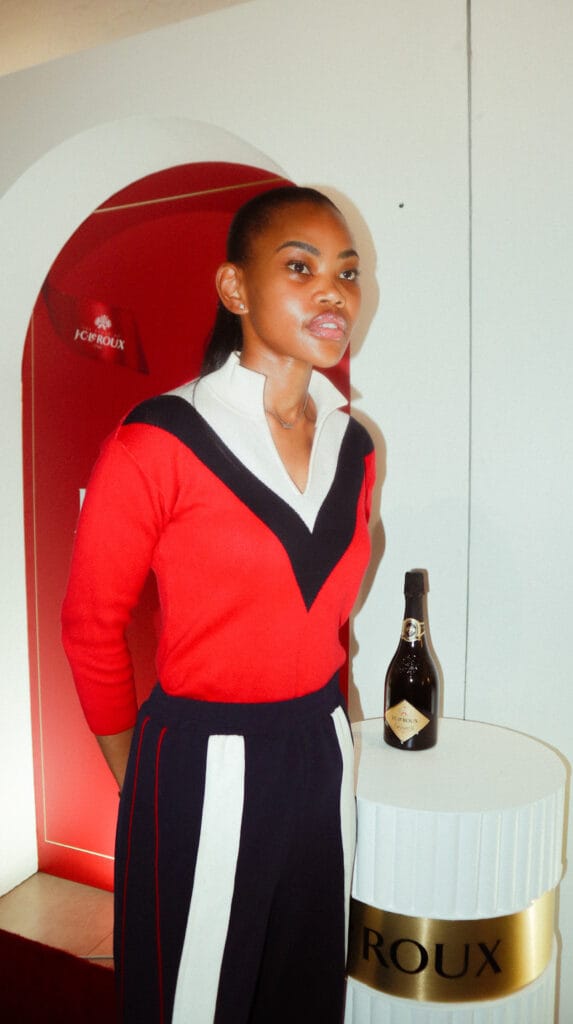
She is especially drawn to concepts of happiness and resilience in Black communities, whose joy persists despite our socio-political realities. “We are still a hopeful society,” she says contemplatively. “I find hope very interesting. What does it mean that in the direst situations, you still have hope?”
Her spirituality is both Christian and intuitive, what she affectionately calls “Woo Woo” grounded in Christianity. Manifestation through prayer, careful journalling, paying attention to synchronicities; to her, these are simply acknowledgements of human power. “We are such powerful beings,” she says in a way that makes you believe it.
Home for Homba is eDutywa, but she grew up in East London, attending Gonubie Primary and later Beaconhurst High School. She beams as she speaks about Beaconhurst, a place she believes shaped her both inside and outside the classroom. Her physics teacher, Miss van de Vyver, saw not her grades first, but her effort. That recognition carried her far. “Her acknowledgement reminded me not to let anything deter me from pursuing a degree in the sciences.”
Would she ever move back permanently? No. Not for her career, not for her future. But for her parents, yes, perhaps in seasons. “I can see time on them now,” she says quietly. “East London is for December, but I might spend months at a time with them one day.”
Reaching the Top 5 of Miss SA taught her a simple but profound lesson: be comfortable with yourself. “If you don’t want something, say so,” she says. “Don’t let things that shine blind you.” She shared this with her sister, Qhawe, now Miss South Africa 2025, along with her most cherished truth: “You being yourself is the most radical thing you can do.” Her reflections on comparison, anxiety and worthiness are so generous, so disarming, that at one point I genuinely felt I was in an intimate TED talk.
For all her expansiveness, Homba’s joy is anchored in simple pleasures. Her absolute favourite tea is the purple-packet Earl Grey from Five Roses; a ritual inherited from her mother. “Anytime I come home, I have to have tea,” she laughs.
When she’s not working, she dissolves into music, researching samples, tracing sounds across decades and continents. She is fascinated by how Western artists weave African and Asian influences into their work. Her recent discovery is that Beyoncé sampled Dougou Dassiri by Dieneba Diakite in one of her songs. Her favourite film is Whiplash. Her current song on repeat is Olivia Dean’s A Couple Minutes.

Shonda Rhimes has been a lifelong muse. As a child, Homba wanted to be a scriptwriter, fascinated by Grey’s Anatomy and the mind behind it. “I think I’m a writer at heart,” she says. “One day, I hope I get over myself and find the discipline to write.”
It is fitting, then, that one of her favourite quotes comes from Haruki Murakami: “A circle with many centres and no circumference.” She made me close my eyes as we imagined it together. A shape without limits, held by many cores, each person their own centre, each life influencing the others in ways both gentle and profound. “We are limitless,” she said, almost to herself.
In the years to come, Homba sees herself becoming more intentional about how she shows up in the world, leaning into social media with focus rather than accident, choosing peace, and believing the beautiful things people say about her.
She wants to live well within her own mind. It is a quiet aspiration, but a powerful one, one that feels entirely aligned with who she is. That was my favourite quote from her throughout the interview: “I want to live well within my own mind.” A sentiment I’m sure we can all resonate deeply with.
In a world that often demands spectacle, Homba Mazaleni offers something far more meaningful: sincere joy, disciplined hope, and the gentle reminder that we are all circles without edges; limitless, interconnected, alive. Through the screen, it’s clear: she already is that centre holding, boundaryless circle. She already lives the expansive life she imagines for others. In choosing joy, not as circumstance but as a conscious act, she invites the rest of us to believe such joy is possible for us too.




No Comments